Description
Transcription
Page header (top of full-page render):
- Page number (left): 392
- Running authors (centre/right): René Kunze and Ernst Pernicka
Figure panels (upper portion of page):
Left photograph:
- No printed text overlay on the photograph itself.
- Scale reference is human hands / a slender metal tool (pointing implement), not a printed bar.
Right photograph:
- Scale bar printed in white on the dark background beneath the specimen:
- Horizontal bar with five vertical tick marks (four equal intervals).
- Label centred under the bar: 5 cm
Figure caption (directly beneath the two photographs, full measure, single paragraph spanning both panels):
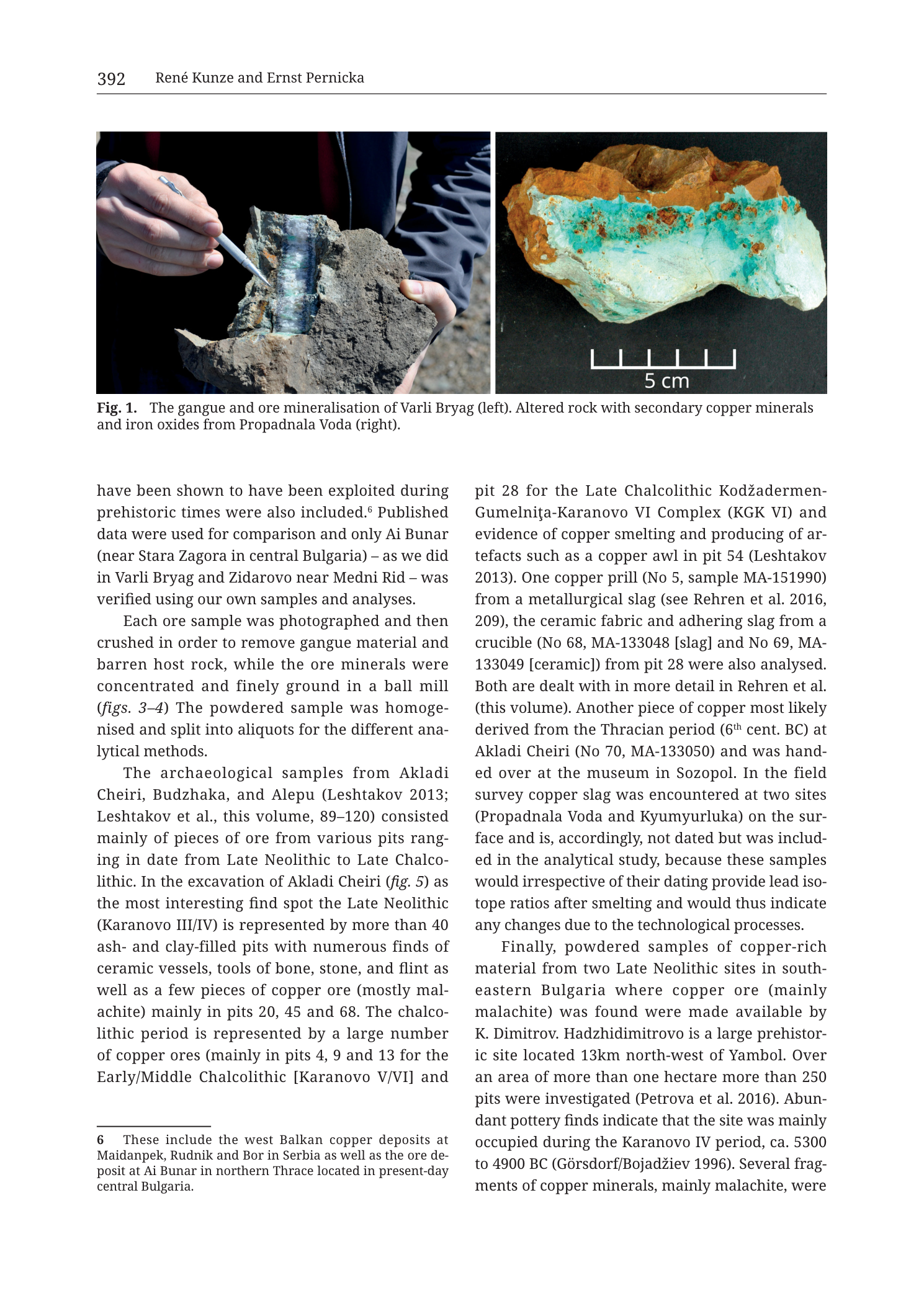
Fig. 1. The gangue and ore mineralisation of Varli Bryag (left). Altered rock with secondary copper minerals and iron oxides from Propadnala Voda (right).
Body text beneath the figure (two columns; transcribed fully as printed on this page):
Left column:
have been shown to have been exploited during prehistoric times were also included.⁶ Published data were used for comparison and only Ai Bunar (near Stara Zagora in central Bulgaria) – as we did in Varli Bryag and Zidarovo near Medni Rid – was verified using our own samples and analyses.
Each ore sample was photographed and then crushed in order to remove gangue material and barren host rock, while the ore minerals were concentrated and finely ground in a ball mill (figs. 3–4) The powdered sample was homogenised and split into aliquots for the different analytical methods.
The archaeological samples from Akladi Cheiri, Budzhaka, and Alepu (Leshtakov 2013; Leshtakov et al., this volume, 89–120) consisted mainly of pieces of ore from various pits ranging in date from Late Neolithic to Late Chalcolithic. In the excavation of Akladi Cheiri (fig. 5) as the most interesting find spot the Late Neolithic (Karanovo III/IV) is represented by more than 40 ash- and clay-filled pits with numerous finds of ceramic vessels, tools of bone, stone, and flint as well as a few pieces of copper ore (mostly malachite) mainly in pits 20, 45 and 68. The chalcolithic period is represented by a large number of copper ores (mainly in pits 4, 9 and 13 for the Early/Middle Chalcolithic [Karanovo V/VI] and
Footnote at bottom of left column:
6 These include the west Balkan copper deposits at Maidanpek, Rudnik and Bor in Serbia as well as the ore deposit at Ai Bunar in northern Thrace located in present-day central Bulgaria.
Right column (continuation):
pit 28 for the Late Chalcolithic Kodžadermen-Gumelniţa-Karanovo VI Complex (KGK VI) and evidence of copper smelting and producing of artefacts such as a copper awl in pit 54 (Leshtakov 2013). One copper prill (No 5, sample MA-151990) from a metallurgical slag (see Rehren et al. 2016, 209), the ceramic fabric and adhering slag from a crucible (No 68, MA-133048 [slag] and No 69, MA-133049 [ceramic]) from pit 28 were also analysed. Both are dealt with in more detail in Rehren et al. (this volume). Another piece of copper most likely derived from the Thracian period (6th cent. BC) at Akladi Cheiri (No 70, MA-133050) and was handed over at the museum in Sozopol. In the field survey copper slag was encountered at two sites (Propadnala Voda and Kyumyurluka) on the surface and is, accordingly, not dated but was included in the analytical study, because these samples would irrespective of their dating provide lead isotope ratios after smelting and would thus indicate any changes due to the technological processes.
Finally, powdered samples of copper-rich material from two Late Neolithic sites in southeastern Bulgaria where copper ore (mainly malachite) was found were made available by K. Dimitrov. Hadzhidimitrovo is a large prehistoric site located 13km north-west of Yambol. Over an area of more than one hectare more than 250 pits were investigated (Petrova et al. 2016). Abundant pottery finds indicate that the site was mainly occupied during the Karanovo IV period, ca. 5300 to 4900 BC (Görsdorf/Bojadžiev 1996). Several fragments of copper minerals, mainly malachite, were
(Text cuts off at the bottom of the page render; the last printed line of the right column ends mid-sentence after “mainly malachite, were”.)
No axis labels, no coordinate grid, no map legend, no north arrow.
Description
TYPE & PURPOSE
This is a two-panel photographic figure illustrating natural copper-ore mineralisation specimens used in the geochemical / isotope sampling programme of Kunze & Pernicka (Krauss et al. 2020 monograph chapter). The caption pair assigns each panel a distinct deposit:
- Left — gangue and ore mineralisation of Varli Bryag (Varli Bryag ore field, near Medni Rid / Burgas district).
- Right — altered rock with secondary copper minerals and iron oxides from Propadnala Voda (one of the five classic Rosen-field / Medni Rid deposits).
Purpose: visual documentation of the macroscopic appearance of the ores before crushing, concentration, and laboratory analysis (context given by the surrounding sample-preparation paragraph), and to contrast a primary vein-in-host style mineralisation (left) with a secondary/supergene copper–iron oxide assemblage (right).
PANEL LAYOUT
- Two photographs in a horizontal pair, equal height, separated by a narrow white gutter.
- Left panel slightly wider in crop feel (field/hand specimen view); right panel is a studio/specimen close-up on black background with a printed scale.
- Single shared caption beneath both.
LEFT PANEL — Varli Bryag gangue and ore mineralisation
What is shown
- A field / hand-specimen view: a person (torso in black jacket, living-skin hands only) holds a rough, dark grey to brownish-grey rock block in the left hand and points with a slender silver metal tool (pen, awl, or fine pick) held in the right hand.
- Background is outdoor/out-of-focus grey-green (ground or distant vegetation), indicating a field or rucksack context rather than a black studio backdrop.
Specimen features
- Host/gangue rock: dark, rough, irregular block with a weathered outer surface; appears siliciclastic or volcanogenic host / vein wall-rock (exact lithology not labelled on the photo).
- Ore mineralisation: a prominent vertical to steeply planar pale blue-green vein / mineralised seam cuts through the block. The pointer tip is aimed exactly at the upper portion of this coloured seam.
- Colour of the mineralised fill: turquoise to pale blue-green — consistent with secondary copper carbonates/silicates (malachite/chrysocolla or mixed Cu secondary minerals) and/or a distinctly copper-stained vein fill nested in darker gangue. The caption’s phrase “gangue and ore mineralisation” matches this vein-in-host geometry.
- Vein geometry visible in the photo: roughly straight, cm-scale width, continuous across much of the visible face; contacts with dark host are sharp to slightly diffuse.
- Texture of host: granular/porous weathered surfaces, no polished or cut face — the block is a broken hand specimen, not a slab.
Scale / orientation
- No printed numerical scale on the left panel. Absolute size is given only by adult human hands: the block spans roughly from palm to fingers (order of ~10–20 cm across the long axis — visual estimate only).
- Orientation of the specimen is as held, not a geographic orientation; the pale seam is presented near-vertical in the photo frame for clarity. No north arrow.
Lighting
- Diffuse daylight; metal tool catches a specular highlight; blue-green vein is clearly lit enough to contrast against dark gangue.
RIGHT PANEL — Propadnala Voda altered rock with secondary Cu minerals and iron oxides
What is shown
- Studio-style specimen photograph of a single irregular rock fragment against a solid black background.
- No hands, tools, or field context.
Specimen features
- Overall shape: flattened, irregular lobate fragment, longer than tall; approx. 10+ cm longest dimension if read against the 5 cm scale bar (visual: the specimen span is more than twice the 5 cm bar, on the order of ~12–15 cm maximal length — estimate).
- Colour zoning (key contents named by the caption):
- Secondary copper minerals — bright turquoise to cyan-green crusts and coatings occupying much of the central and lower face of the specimen. Colour and earthy/microcrystalline surface texture are consistent with malachite and/or other secondary Cu carbonates/silicates as the dominant green phase. Local brighter emerald blebs and powdery coatings are visible.
- Iron oxides — orange, ochre, and rust-brown patches, especially along the upper-right and upper rim of the specimen, and as scattered flecks through the green zone. These are the iron-oxide / gossanous component of the assemblage.
- Host/altered rock — pale cream to light beige matrix exposed where coatings are thinner (left-lower and scattered windows); outer weathered rind is irregular, whitish-buff to tan.
- Texture: rough, earthy, porous — typical of altered/gossanous oxidised ore rather than fresh massive sulphide. No fresh metallic sulphide gleam is obvious at this lighting; the specimen is oxidised.
- No vein geometry as sharp as the left panel; mineralisation is a surface coating / replacement crust on altered rock.
Scale
- White scale bar with four equal divisions and label 5 cm. Full bar length = 5 cm; each tick interval ≈ 1.25 cm.
- Specimen longest axis is substantially larger than the bar (several times the 5 cm length in the long direction of the rock).
Lighting
- Even studio illumination against black seamless ground; copper greens and iron oranges are high-chroma and easily distinguished.
COMPARISON BETWEEN PANELS (analytical)
| Aspect | Left (Varli Bryag) | Right (Propadnala Voda) |
|---|---|---|
| Context | Field/hand-held | Studio still-life |
| Deposit | Varli Bryag ore field | Propadnala Voda (Medni Rid / Rosen field) |
| Style | Vein / seam of Cu mineralisation in dark gangue | Altered rock coated by secondary Cu + Fe oxides |
| Supergene character | Blue-green fill suggests secondary Cu in a primary structural seam | Explicitly secondary Cu minerals + iron oxides (gossan-type coating) |
| Scale device | Human hands + tool | Printed 5 cm bar |
| Caption keyword | “gangue and ore mineralisation” | “altered rock with secondary copper minerals and iron oxides” |
Together the pair shows the macroscopic ore types entering the Kunze/Pernicka analytical pipeline for the Medni Rid / Varli Bryag / Propadnala Voda regional comparison (chapter text on sample prep, crushing, ball-mill grinding — figs. 3–4 referenced for powdered product).
RELATIONSHIP TO SURROUNDING TEXT (on-page, not figure overlay)
The body text is methodological / sample-inventory prose for the same chapter, not a second caption. Relevant names tied into the figure’s deposits and programme:
- Comparative verification deposits: Ai Bunar (central Bulgaria), plus Varli Bryag and Zidarovo near Medni Rid (authors’ own samples).
- West Balkan comparison set in footnote 6: Maidanpek, Rudnik, Bor (Serbia); Ai Bunar again.
- Archaeological ore/slag sample series: Akladi Cheiri, Budzhaka, Alepu; pits and sample IDs (e.g. MA-151990 copper prill; MA-133048/133049 crucible slag/ceramic; MA-133050 Thracian copper); surface copper slag at Propadnala Voda and Kyumyurluka (spelling as printed in this paragraph).
- Additional powdered Cu-rich material from Hadzhidimitrovo (Yambol district) supplied by K. Dimitrov.
- Lab pathway: photograph → crush → remove gangue → concentrate ore minerals → ball mill (figs. 3–4) → homogenise → aliquot for analytical methods (including lead isotopes referenced for slag).
These text links place Fig. 1 as the visual opener of the ore-character chapter (Kunze/Pernicka), with Varli Bryag and Propadnala Voda as flagship hand-specimen examples of the geological end-member ores.
GEOLOGICAL / MINERALOGICAL CONTENT (inferred strictly from photo + caption)
- Varli Bryag (left): copper ore mineralisation as a discrete coloured seam within dark gangue/host — primary structural control preserved; secondary Cu colouring of the seam fill is probable but not labelled to species.
- Propadnala Voda (right): secondary copper minerals (green; malachite/related) plus iron oxides (orange–brown) on altered rock — classic near-surface oxidised/gossan-style assemblage of the Rosen ore field oxide zone, matching other malachite documentation in the collection (e.g. Tzankova Fig. 2 malachite samples).
- No thin-section textures, no SEM scale, no assay numbers on the figure itself.
SCALE SUMMARY
- Left: human-hand scale only (~dm specimen).
- Right: explicit 5 cm bar beneath specimen.
- No map scale, no coordinate grid — Consistency Check for UTM centroids does not apply.
RELATIONSHIP TO OTHER FIGURES
- This is Fig. 1 of the Kunze & Pernicka chapter in Krauss et al. 2020 (running head; filename
Tub_p394vs printed page 392). - Same-chapter forward references on this page: figs. 3–4 (ball-mill / powdered sample stage), fig. 5 (Akladi Cheiri excavation).
- Cross-chapter / external: Rehren et al. 2016 and Rehren et al. (this volume) for metallurgical slag/crucible analyses; Leshtakov 2013 and Leshtakov et al. this volume 89–120 for Akladi Cheiri/Budzhaka/Alepu archaeology; Petrova et al. 2016 and Görsdorf/Bojadžiev 1996 for Hadzhidimitrovo.
- Collection companions: Tzankova 2023 Fig. 2 (malachite samples) and Fig. 3 (SEM malachite) document similar secondary Cu phases petrographically; catalogue plates for Propadnala Voda and Varli Bryag place the deposits geographically; LiDAR Fig. 16 (Kyumyurlaka) and related Medni Rid reliefs place the field context of Propadnala Voda’s sibling deposits.
Consistency Check
- Centroid: none printed (photographs of hand specimens, not a site map).
- Map bounds: N/A.
- Result: N/A.
Notes
- Filename encodes
Tub_p394while the printed page number on this render is 392; figure number is unambiguously Fig. 1 of Kunze & Pernicka. Likely PDF-page vs book-pagination offset; both recorded. - Caption deposit spellings: “Varli Bryag” (left), “Propadnala Voda” (right). Body text also uses “Kyumyurluka” (one “r”) for the slag-find site — transcribed as printed; neighbouring figures often use “Kyumyurlaka”.
- Species names (malachite, chrysocolla, etc.) are not printed on the figure panels; green secondary Cu and orange iron oxides are identified from colour + caption wording. Body text uses “malachite” for related archaeological ores, supporting but not replacing the caption’s more general “secondary copper minerals”.
- Filename token
gossan_ore_mineralisationis a curator label reflecting the right-panel oxidised assemblage; the printed caption does not use the word “gossan”. - Left-panel absolute centimetre size is not printable-scale-bar locked — reported only via hand size.
- Page truncates mid-sentence at the end of the right column; footnote 6 is complete.
- No UTM / grid / north data on this figure.
- None further.