Description
Transcription
Page header
- Running head (upper right area): “Geology of the Region”
- Page number: 303
Profile title (inside figure frame, top centre)
“schematic profile Vărli Brjag”
Orientation labels (inside figure frame)
- Upper left: “NW” above “300°”
- Upper right: “SE” above “120°”
Dimensional / attitude annotations (on the drawing)
- Double-headed horizontal arrow across the open pit / mined-out surface gap at top of the vein: “3-6m”
- Dip symbol (right side of frame): vertical reference line with a dashed arc/wedge and label “75-80°” — indicated dip of the vein structure
Legend (left side of figure frame, top → bottom)
-
■ (green) — core zone
oxidized copper minerals, copper sulfides
chalkopyrite, chalcocite, covellite,
haematite, quartz -
■ (red / scarlet) — peripheral zone
quartz, haematite,
minor oxidized
copper minerals -
□ (pale beige / light grey-tan outlined box) — wall rock
silicified -
linework sample (thin dark lines, some with boxwork hash) — quartz-hematite veins
with boxwork -
hatched rectangle (diagonal black stripes) — fillings
Main drawing (centre-right of frame)
- Steeply dipping composite vein structure drawn from upper surface down through the frame, plunging from upper-centre toward lower-centre/right (overall NW-high to SE-low attitude consistent with NW→SE profile looking along/slightly across a steep vein).
- Green core zone: central elongate green band along the vein axis, widest mid-section, tapering; hosts the principal copper mineral assemblage per legend.
- Red peripheral zone: thick red envelopes on both hanging-wall and footwall sides of the green core, forming the bulk of the exposed vein walls from surface down; continuous red mass left and right of the green core.
- Pale beige wall rock: fills the remainder of the frame outside the red envelopes; labelled silicified.
- Surface expression: top of the structure is an open, beige-walled notch/pit between the two red walls; horizontal span of the open gap marked 3–6 m. Internal pale fill/hatching in the upper pit area represents fillings / mined-out space.
- Quartz-hematite veins with boxwork: numerous thin dark anastomosing veinlets drawn inside the red peripheral zones (especially left/red NW side and right/red SE side) and some traces into green core; open mesh/boxwork line clusters drawn particularly in the upper-central red–green contact region and mid-vein.
- Fillings: diagonal hatch ornament in parts of open spaces / internal voids (upper central cavity and local patches).
- No lithology outside the vein/wall-rock system is differentiated; no topographic elevation scale, no depth scale bar in metres, no sample numbers.
Figure caption (directly under the frame)
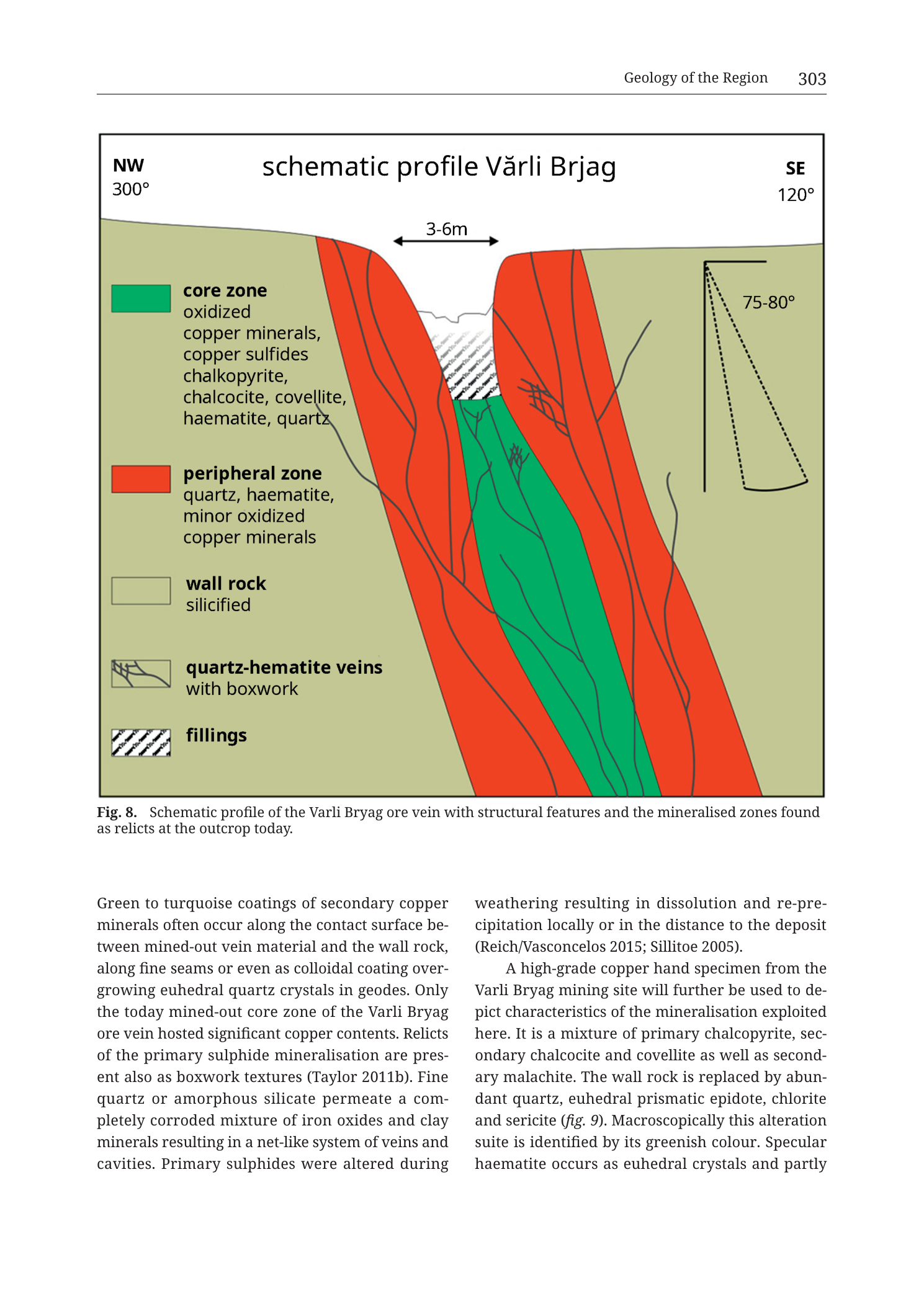
“Fig. 8. Schematic profile of the Varli Bryag ore vein with structural features and the mineralised zones found as relicts at the outcrop today.”
Body text on the same page (two columns beneath the figure)
Left column:
“Green to turquoise coatings of secondary copper minerals often occur along the contact surface between mined-out vein material and the wall rock, along fine seams or even as colloidal coating overgrowing euhedral quartz crystals in geodes. Only the today mined-out core zone of the Varli Bryag ore vein hosted significant copper contents. Relicts of the primary sulphide mineralisation are present also as boxwork textures (Taylor 2011b). Fine quartz or amorphous silicate permeate a completely corroded mixture of iron oxides and clay minerals resulting in a net-like system of veins and cavities. Primary sulphides were altered during”
Right column:
“weathering resulting in dissolution and re-precipitation locally or in the distance to the deposit (Reich/Vasconcelos 2015; Sillitoe 2005).
A high-grade copper hand specimen from the Varli Bryag mining site will further be used to depict characteristics of the mineralisation exploited here. It is a mixture of primary chalcopyrite, secondary chalcocite and covellite as well as secondary malachite. The wall rock is replaced by abundant quartz, euhedral prismatic epidote, chlorite and sericite (fig. 9). Macroscopically this alteration suite is identified by its greenish colour. Specular haematite occurs as euhedral crystals and partly“
[text cuts off mid-sentence at page end — continues on following page, not in this PNG.]
Description
TYPE & PURPOSE
This is a schematic vertical profile (cross-section) of a single ore vein at the Varli Bryag (Vărli Brjag) mining site, SE Bulgaria. It is not a regional crustal section; it is an outcrop- to stopes-scale interpretation of one steep mineralised vein, showing:
- concentric mineralised zoning (green core vs red peripheral zones);
- silicified wall rock;
- internal quartz–hematite veins with boxwork;
- fillings of open space;
- geometric attitude (NW 300° → SE 120° profile; vein dip 75–80°);
- surface mined-out width (3–6 m).
Purpose: document the mineralised zones and structural features still visible as relicts at outcrop today after mining of the copper-rich core — the caption’s explicit framing. Supports the same-page text that only the (now mined-out) core zone held significant copper, while peripheral zones and boxwork preserve the weathering path from primary sulphides to oxidized assemblages.
FRAME, EXTENT, ORIENTATION
- Single rectangular framed diagram occupying the upper portion of page 303; legend left; vein drawing centre-to-right; caption beneath; two-column body text below.
- Profile azimuth: labelled NW (300°) at left end and SE (120°) at right end — a vertical plane striking roughly 300–120°, i.e. viewing a structure that dips steeply (75–80°) within/across that plane.
- No north arrow for map space (not a map). No geographic place names beyond the title “Vărli Brjag” / caption “Varli Bryag”.
- Vertical extent: qualitative from surface pit down through the drawn height of the red–green vein; no numeric depth scale (metres below surface) is printed.
SCALE
- Only numeric scale-like annotation: surface open width of the vein/pit = 3–6 m (double-headed arrow at top).
- Dip annotation: 75–80°.
- No horizontal or vertical bar scale for the full drawing; the figure is explicitly “schematic”. Vein thickness (core + both peripheral envelopes together) is several times the 3–6 m surface gap towards depth as drawn, but absolute depths are not graduated.
COORDINATES / GRID
- None. Catalogue-style UTM consistency check does not apply.
TRACE / HORIZONTAL & VERTICAL AXES
- Trace: schematic profile through the Varli Bryag ore vein (not tied to a lettered A–A′ map line on this page).
- Horizontal sense: NW (300°) left → SE (120°) right.
- Vertical: up = surface/topography (flat ground line with a central pit notch); down = into the vein at steep dip. No elevation datum (m a.s.l.) or depth ticks.
- Vertical exaggeration: not stated; schematic drafting moderately thickens zones for readability relative to the 3–6 m surface label.
SURFACE TOPOGRAPHY ALONG THE TRACE
- Nearly flat ground surface line across the top of the wall-rock field.
- Central mined-out notch / open cut where the vein reaches surface: walls of red peripheral zone drop into a gap 3–6 m wide; pale wall-rock and hatched fillings occupy the pit floor/void. Surface topographic relief other than this pit is not shown.
GEOLOGICAL / MINERALIZED ZONES (core → outward)
-
Core zone (green)
- Central axial ribbon of the vein.
- Mineralogy (legend): oxidized copper minerals; copper sulfides — chalkopyrite [= chalcopyrite], chalcocite, covellite, haematite, quartz.
- Text reinforcement: only this core hosted significant copper contents; today it is largely mined out; secondary green–turquoise Cu coatings common on remaining contacts; primary sulphide relicts also as boxwork. Hand-specimen assemblage named in text: primary chalcopyrite + secondary chalcocite, covellite, malachite.
-
Peripheral zone (red)
- Thick envelopes on both sides of the green core, continuous from surface to the bottom of the drawing.
- Mineralogy (legend): quartz, haematite, minor oxidized copper minerals.
- Constitutes most of the standing vein walls seen at outcrop after core extraction.
-
Wall rock (beige)
- Host rock outside the red envelopes.
- Legend: silicified.
- Body text / forward reference to fig. 9: wall rock replaced by abundant quartz, euhedral prismatic epidote, chlorite and sericite; macroscopically greenish alteration; specular haematite as euhedral crystals (sentence continues off-page).
-
Quartz–hematite veins with boxwork
- Thin dark anastomosing veinlets and meshworks drawn inside peripheral (and partly core) zones.
- Represent the net-like quartz / amorphous silicate + iron-oxide + clay system after sulphide corrosion (text); boxwork = relict sulphide texture (Taylor 2011b cited).
-
Fillings
- Diagonal hatch in open spaces (upper pit cavity and local voids) — secondary or residual fillings of cavities left by mining and/or dissolution.
STRUCTURAL FEATURES
- Attitude: vein dips 75–80° (steep); profile ends NW 300° / SE 120° fix the vertical section azimuth.
- Zonation geometry: classic wall-to-core banding — silicified wall rock | red peripheral zone | green core | red peripheral zone | silicified wall rock — approximately planar, steep, with some pinch-and-swell of the green core and irregularity of red walls.
- Internal structure: subparallel to anastomosing quartz–hematite veinlets within the red zone; boxwork domains; open-space fillings in the mined upper core.
- Mining modification: surface core razed to a 3–6 m gap — the profile is an exhumed / partially mined state, not a pristine pre-mining section. Caption: zones “found as relicts at the outcrop today”.
- No faults, folds, intrusive contacts, or stratigraphic bedding of country rock outside the vein system are drawn.
- No boreholes.
SUPERGENE VS HYPOGENE
- Explicitly a weathered / supergene-overprinted vein outcrop model:
- Primary sulphides altered during weathering → dissolution and local or distal re-precipitation (Reich/Vasconcelos 2015; Sillitoe 2005).
- Core zone mineral list mixes primary copper sulphide (chalcopyrite) with secondary sulphides (chalcocite, covellite) and oxidized Cu + haematite + quartz.
- Peripheral zone dominated by quartz + haematite ± minor oxidized Cu — the standing gossany/oxidized envelope.
- Boxwork and net-like quartz–iron oxide–clay vein/cavity systems = classic sulphide-weathering textures.
- Secondary Cu coatings (green–turquoise; malachite in specimen text) permanent at vein/wall contacts, seams, and quartz geodes.
COLOUR & SYMBOL SYSTEM
- Green = Cu-rich core (economic zone historically).
- Red = quartz–haematite peripheral envelope.
- Beige = silicified wall rock.
- Black linework = quartz–hematite veins / boxwork.
- Diagonal hatch = fillings / open-space occupancy.
- Olive-grey green map background within the frame is the field against which symbols sit (same as wall-rock family tone in the drawing).
SPATIAL RELATIONSHIPS
- Economic copper is axially concentrated (green core); structural thickness of the mineable core is much less than the full red+green vein width.
- After core extraction, the outcrop presents as a 3–6 m open cut flanked by red peripheral walls still rich in quartz–haematite ± minor oxidized Cu and cut by boxworked quartz–hematite veinlets.
- Steep 75–80° dip means a plan-view trace of the vein would be a narrow linear feature — consistent with red vein lines densing on the Varli Bryag geo-structural map (Tub Fig. 11) as short linear ore structures on the intrusive contact.
- Wall-rock silicification (± epidote–chlorite–sericite per text) forms the immediate alteration halo outside the vein.
RELATIONSHIP TO OTHER FIGURES
- Fig. 8 in the “Geology of the Region” portion of Krauss et al. 2020 (Tübingen), printed page 303 (filename Tub_p305).
- Same-page text points forward to fig. 9 for the high-grade hand specimen / wall-rock alteration mineralogy (that specimen figure is a separate plate).
- Regional context companions in this collection:
- Tub_p026_Fig11 — Varli Bryag ore field geo-structural map (field-scale vein swarm).
- Tub_p023_Fig8 — regional paleovolcano map + crustal Cross-section II-II through Varli Bryag caldera (different “Fig. 8” earlier in the book; same number, different chapter).
- Tub_p024_Fig9 — Rosen geo-structural map (parallel ore-field style).
- Mineral-specimen and SEM figures elsewhere for secondary Cu (malachite, etc.).
- Caption orthography “Varli Bryag” vs title “Vărli Brjag” vs earlier “Varlibrayag” — same locality, variant transliterations across the volume.
Consistency Check
- Not applicable: no UTM centroid and no map-axis coordinates.
Notes
- Filename Tub_p305 vs printed page 303: PDF vs book pagination difference; content identity is this chapter’s Fig. 8 vein profile.
- Profile title uses German-style orthography “Vărli Brjag” (ă, j); caption uses “Varli Bryag”. Both retained.
- Legend mineral spelling retained as printed: “chalkopyrite”, “haematite”, “copper sulfides”, and separate “quartz-hematite” (American “hematite”) in the veinlets line — mixed UK/US haematite/hematite on one plate.
- No depth scale in metres below surface; only surface width 3–6 m and dip 75–80° are numeric. Depth geometry is schematic.
- “Fillings” hatch vs “quartz-hematite veins with boxwork” linework can visually grade into each other in the upper pit — described from legend + dominant ornament regions.
- Body text ends mid-sentence on “partly” at page break.
- This is a vein-scale outcrop schematic, not the regional crustal cross-sections of Tub_p023_Fig8 — do not conflate the two different Fig. 8 plates in the monograph.
- None further.