Description
Transcription
Panel labels (upper-left of each panel):
- a
- b
- c
- d
- e
- f
Scale bars (one per panel, bottom of each photograph, printed on a light card/strip):
- Panel a: 0 …… 5 cm (bar with black/white alternating segments)
- Panel b: 0 …… 5 cm
- Panel c: 0 …… 5 cm
- Panel d: 0 …… 5 cm
- Panel e: 0 …… 5 cm
- Panel f: 0 …… 5 cm
No figure caption, deposit names, sample IDs, mineral names, or legend text are printed on this cropped PNG itself (caption belongs to the parent journal page).
No north arrows, coordinate grids, or map elements.
Description
TYPE & PURPOSE
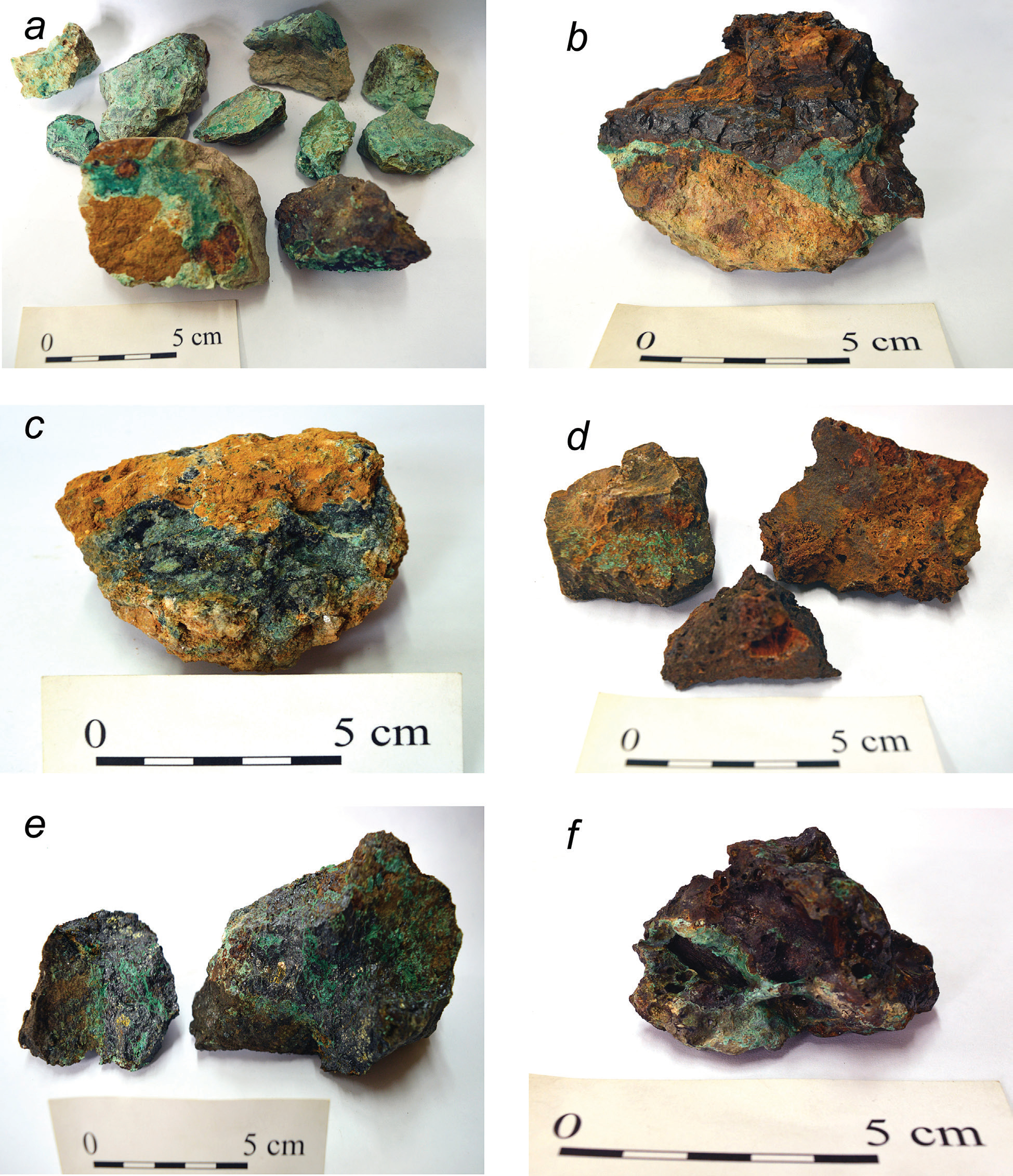
Multi-panel studio photograph plate of hand-specimen copper-ore / secondary-copper mineral samples from the Rosen ore field study set (Tzankova 2023, Fig. 2). The suite documents the visual character of malachite-bearing and related oxidised copper mineralisation — green secondary copper carbonates/oxides associated with brown iron-oxide (limonite/goethite-style) gossanous matrix, dark Mn/Fe-oxide crusts, and in one panel a highly vesicular slag-like or heavily leached porous mass. Purpose: illustrate the macroscopic mineralogy of the deposits located on Fig. 1 before the SEM detail of Fig. 3.
FRAME & LAYOUT
- Six rectangular photograph panels arranged 3 rows × 2 columns:
- Top row: a (left), b (right)
- Middle row: c (left), d (right)
- Bottom row: e (left), f (right)
- Each panel: specimen(s) on a plain white/very pale laboratory background, overhead or high-angle lighting, sharp focus on rock surfaces.
- Each panel carries its own 0–5 cm graphical scale bar on a pale card at the bottom edge.
- No multi-panel explanatory key on the crop; identification of which deposit each letter represents is not printed on this PNG (may exist only in the journal caption).
SCALE
- Uniform stated scale across panels: 5 cm bar from 0 to 5.
- Bars use alternating black and white segments (typically 1 cm major units with finer ticks).
- Absolute specimen sizes below are visual estimates against these bars.
Panel a — multiple small malachite-rich fragments + one larger matrix specimen
Composition. About ten to twelve separate rock pieces scattered on white ground, plus one distinctly larger specimen at lower left of the group.
Larger specimen (lower-left of group):
- Irregular block roughly ~4–5 cm long.
- Matrix is ochre-brown to tan iron-oxide / weathered host, with irregular patches and coatings of bright to medium green malachite (and possibly mixed green copper secondaries) invading and coating the brown ground.
- Green forms diffuse patches and thin films rather than a monomineral green mass; brown oxidised zones remain dominant in area.
Smaller fragments (cluster above and right of large piece):
- Majority are strongly green, malachite-dominated chips from ~1 cm to ~3 cm.
- Colours range from pale mint/apple green through rich emerald to slightly blue-green.
- Textures: earthy to finely crystalline crusts and massive green aggregates; some chips show mixed green-on-brown or green-on-grey interiors.
- One darker brown–blackish piece with green surface dusting sits lower-right of the cluster (more gossanous / less purely malachite).
- One tiny pale green chip at far upper-left.
Interpretation (observed). Panel a emphasises high-grade green secondary copper carbonate (malachite) pieces mixed with a larger malachite-in-limonitic-matrix specimen — the “clean” green end-member of the suite.
Panel b — single large zoned specimen (dark crust over brown + green band)
Composition. One large irregular hand specimen, roughly ~7–9 cm wide against the 5 cm bar.
Colour zonation (distinct bands/domains):
- Dark brown-black to black upper/central domain — knobbly, cracked, almost slaggy or heavily Mn/Fe-oxide-encrusted surface with blocky fracture relief.
- Ochre to orange-brown body dominating the left and lower mass — porous, earthy limonitic / goethitised oxide gossan texture.
- Bright turquoise-green malachite band/lens running roughly through the middle-right of the specimen as a coherent green strip between the dark crust and the brown body, with additional green coatings on lower-right edges.
Texture. Rugose, vuggy oxide surface; green mineral appears as coating and as a more continuous seam. No fresh primary sulphide metallic yellow is obvious at this resolution — specimen reads as supergene oxide-zone ore.
Interpretation (observed). Classic gossanous copper ore with malachite developed along a zone beneath/beside a dark oxide crust — intermediate character between pure green chips (a) and brown-dominated pieces (d).
Panel c — single specimen, thick green-blue secondary coat on ochre matrix
Composition. One elongated hand specimen, roughly ~6–8 cm long.
Colour / mineral domains:
- Upper surface: rough orange-ochre to yellow-brown iron-oxide earthy crust, granular.
- Lower and flank surfaces: thick coating of dark green to blue-green secondary copper minerals (malachite ± possible chrysocolla/azurite-tinted greens), with almost black-green patches where the coat is thickest or mixed with dark oxides.
- Contact between ochre top and green flanks is irregular and embayed — green appears to replace or coat the oxide matrix from outside/edges.
Texture. Coarse, pan-like upper oxide; greasy to dull green secondary coat with small bumps and pits. Specimen sits low and wide on the scale card.
Interpretation (observed). Strongly malachite-/green-copper-coated oxide ore, greener overall than panel b’s mixed seamed piece, browner-matrix than panel a’s pure chips.
Panel d — three brown gossanous fragments with minor green
Composition. Three separate pieces:
- Left: blocky brown fragment ~3–4 cm, with minor green malachite films on faces and edges.
- Right: larger, more angular/platey brown fragment ~4–5 cm, porous brown oxide, trace green only.
- Bottom-centre: smaller triangular/wedge fragment ~2–3 cm, dark brown with a red-brown hollow / cavity on the broken face (possibly a leached cast or vug with haematitic lining).
Colour. Dominantly brown to chocolate and rust iron oxides; green is subordinate thin coating, not bulk mineral.
Interpretation (observed). Gossan / iron-oxide-dominated specimens with only accessory malachite — the Cu-poor or less-enriched oxidised end of the illustrated set, useful contrast to panels a–c.
Panel e — two dark, green-dusted massive specimens
Composition. Two pieces side by side:
- Left: smaller, ~3–4 cm, dark grey-black with speckled bright green malachite dusting and minor yellow-brown spots.
- Right: larger, ~5–6 cm, same dark base lithology/oxide, more extensive green surface coating and some brown iron-oxide patches on the upper right.
Texture. Dense, somewhat lumpy to finely crystalline dark groundmass; green occurs as thin coatings, speckles, and small patches rather than thick monomineral crusts. Surfaces catch light with a slightly metallic or submetallic glint in places (possible residual sulphide or specular oxide — not resolvable to species here).
Interpretation (observed). Darker, more massive/reduced-looking host or mixed primary–secondary ore with malachite as surface alteration — distinct from the bright earthy green chips of (a) and the porous brown gossans of (d).
Panel f — single highly vesicular / scoriaceous dark mass with green coatings
Composition. One irregular specimen, roughly ~6–8 cm long, highly contorted outline.
Texture (dominant feature). Extremely porous, vesicular, scoriaceous / slag-like framework: large irregular voids, rounded cavities, and thin walls of dark brown-black material. In places the porosity resembles cellular gossan after sulphide leaching or a pyrometallurgical slag; from the photograph alone, genetic assignment (natural vs metallurgical) is not certain — only the texture is observed.
Colour. Dark brown to black groundmass; green malachite films lining some cavity walls and coating exterior lobes; minor copper-blue/green iridescence in recesses; hints of brown internal oxide.
Interpretation (observed). Most texturally extreme piece on the plate — highly leached porous oxide ore or slag-like mass with secondary green copper minerals in voids. Of particular archaeometallurgical interest if slag, but the journal context (malachite samples from Rosen deposits per Fig. 2 series) more likely frames it as natural porous ore/gossan unless the caption states otherwise (caption not on this PNG).
CROSS-PANEL COMPARISON & SPATIAL/MINERAL RELATIONSHIPS
| Panel | Pieces | Dominant character | Green malachite | Brown Fe-oxide | Dark crust / massive |
|---|---|---|---|---|---|
| a | many small + 1 large | High-grade green chips | Abundant | On large piece | Minor |
| b | 1 large | Zoned gossan + green seam | Distinct band | Major body | Heavy black top crust |
| c | 1 large | Green coat on ochre | Thick flanks | Ochre top | Dark-green patches |
| d | 3 | Brown gossan | Trace films | Dominant | Cavity in small piece |
| e | 2 | Dark massive + green dust | Speckled coats | Minor patches | Dark groundmass |
| f | 1 | Vesicular/scoriaceous | Void linings | Dark-brown walls | Cellular framework |
Together the six panels span the supergene copper-oxide assemblage expected in the Rosen-field deposits of Fig. 1: malachite as the conspicuous green secondary phase, hosted by or coating limonitic gossan and darker oxide/massive substrates. No primary chalcopyrite/bornite brass-yellow colour is clearly exhibited as fresh sulphide masses at this scale — consistent with a paper focus on secondary malachite chemistry/mineralogy (and SEM Fig. 3).
RELATIONSHIP TO OTHER FIGURES
- Companion to Fig. 1 (geological map locating Rosen, Korucheshme, Meden Rid, Sarneshko Kladenche, Propadnala Voda) — these specimens are the studied copper-mineral materials from that field.
- Companion to Fig. 3 (SEM imagery of malachite) — Fig. 2 is the hand-specimen scale; Fig. 3 the microscopic.
- No panel-to-deposit letter key is printed on this crop; do not invent which letter = which mine without the journal caption.
Notes
- Journal caption text is absent from this PNG crop; panel letters a–f are not expanded to deposit or sample IDs here. Source/page (Tzankova 2023, Fig. 2) from filename and series identity.
- Mineral names beyond the visually diagnostic green malachite-group secondary copper carbonate and brown iron oxides are not labelled on the image; chrysocolla, azurite, cuprite, tenorite, etc. are not asserted unless colour uniquely demands it (no clear deep-blue azurite masses stand out).
- Panel f’s vesicular texture could represent natural cellular gossan or anthropogenic slag; without caption confirmation it is described structurally only.
- Scale bars are all 5 cm but card widths differ slightly between panels; size estimates are approximate.
- No UTM/coordinate content — Consistency Check N/A.
- None further.